Media and Reviews

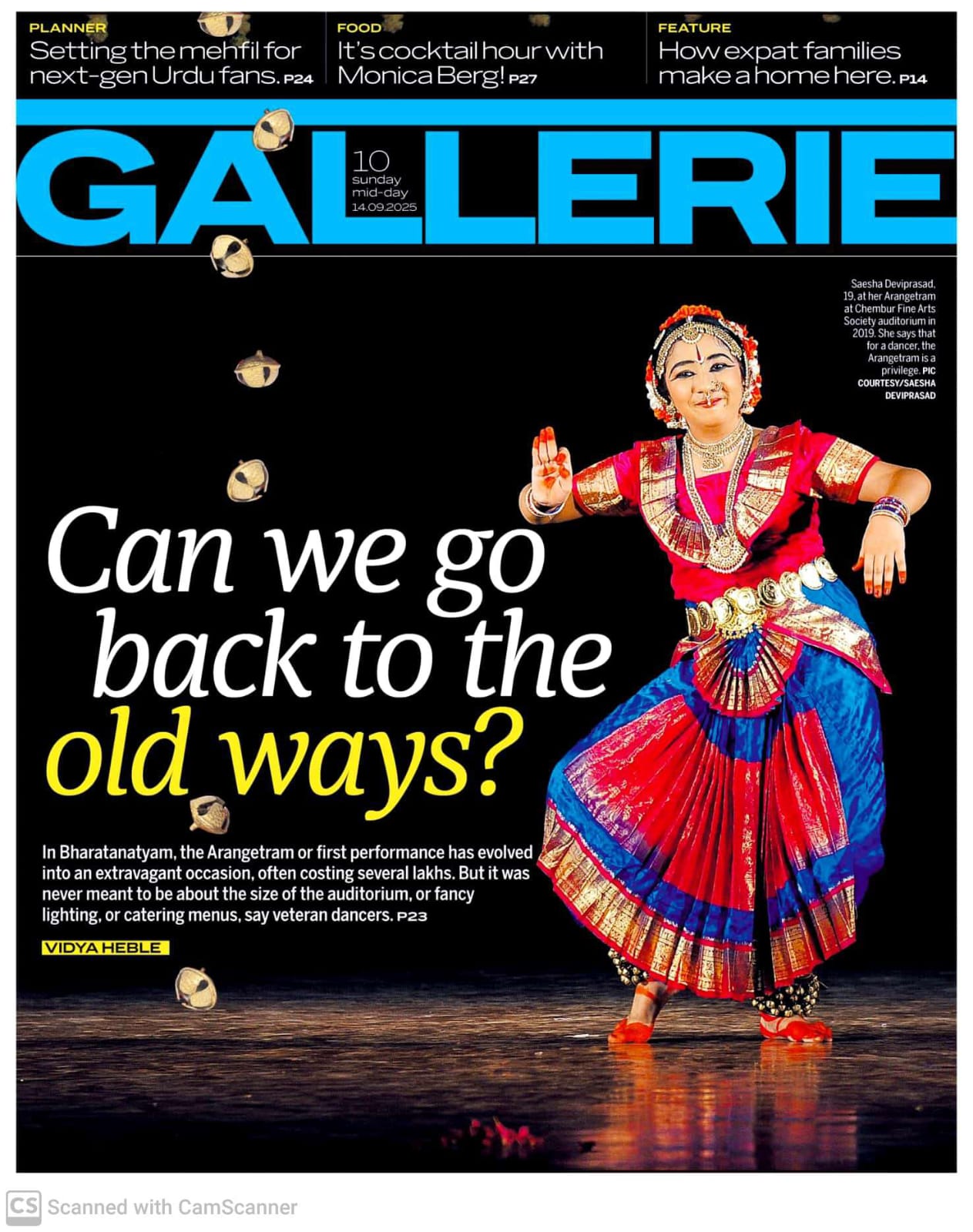
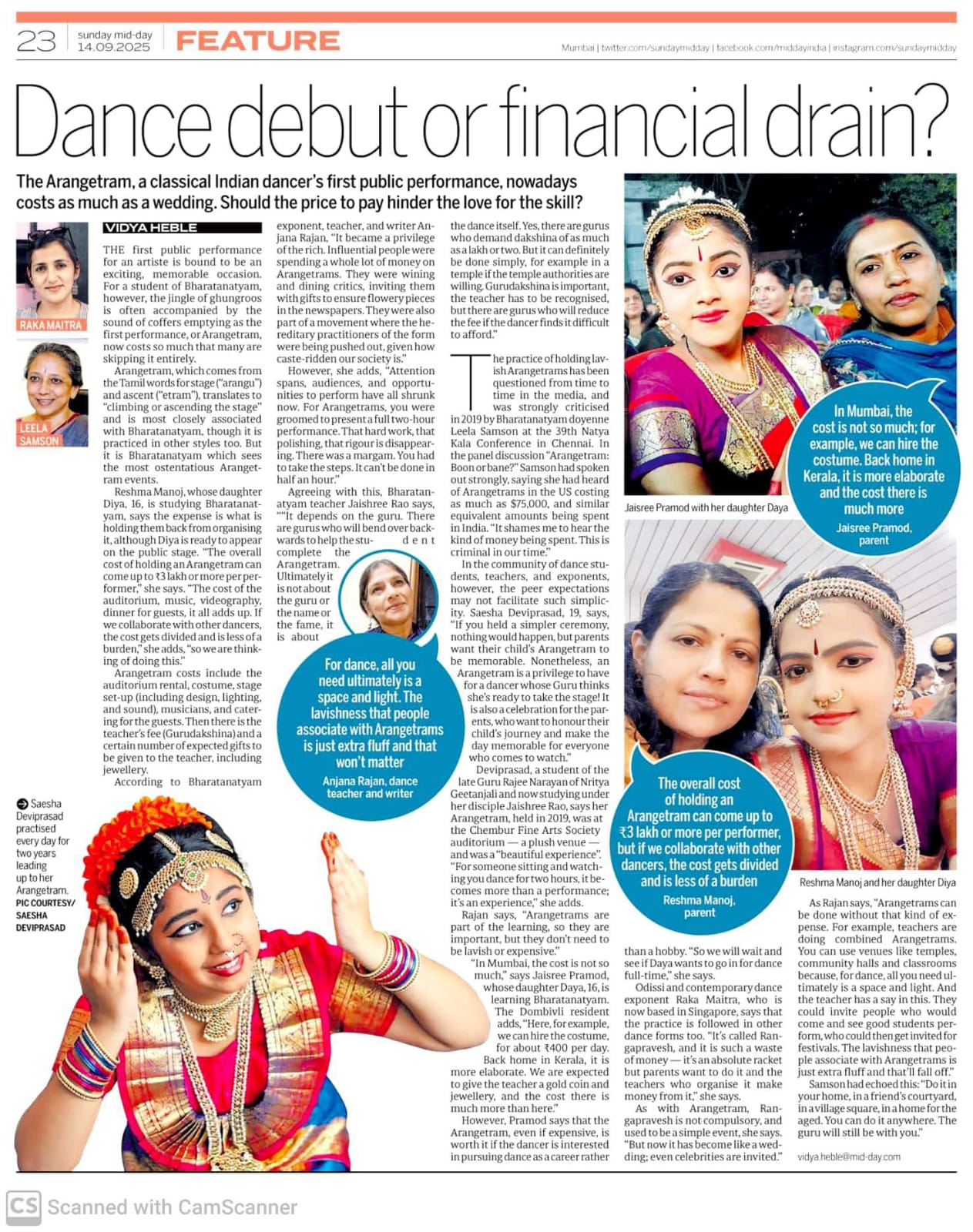
Can we go back to the old ways?

Sunday Midday 14 Sept 2025 – article

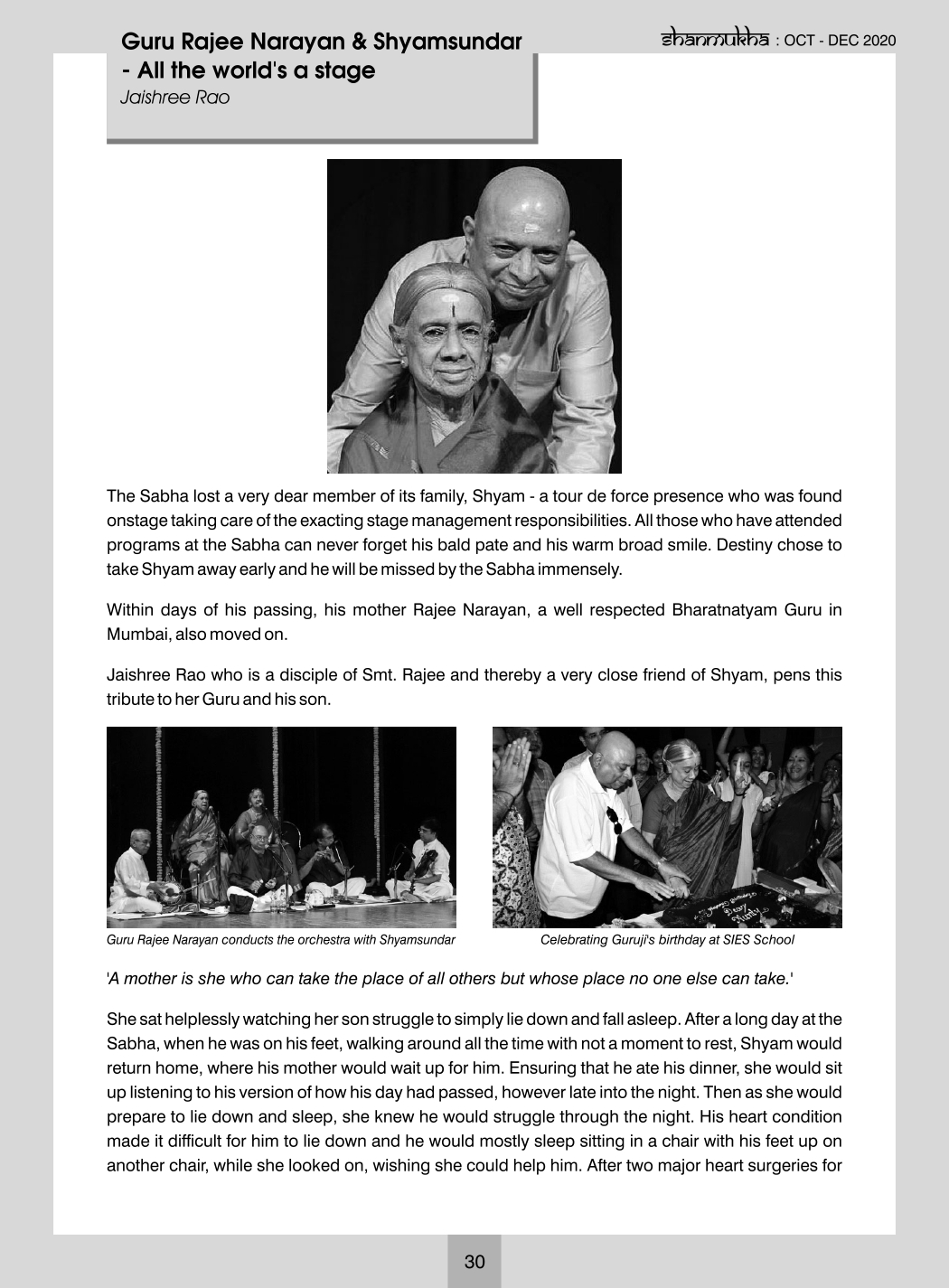
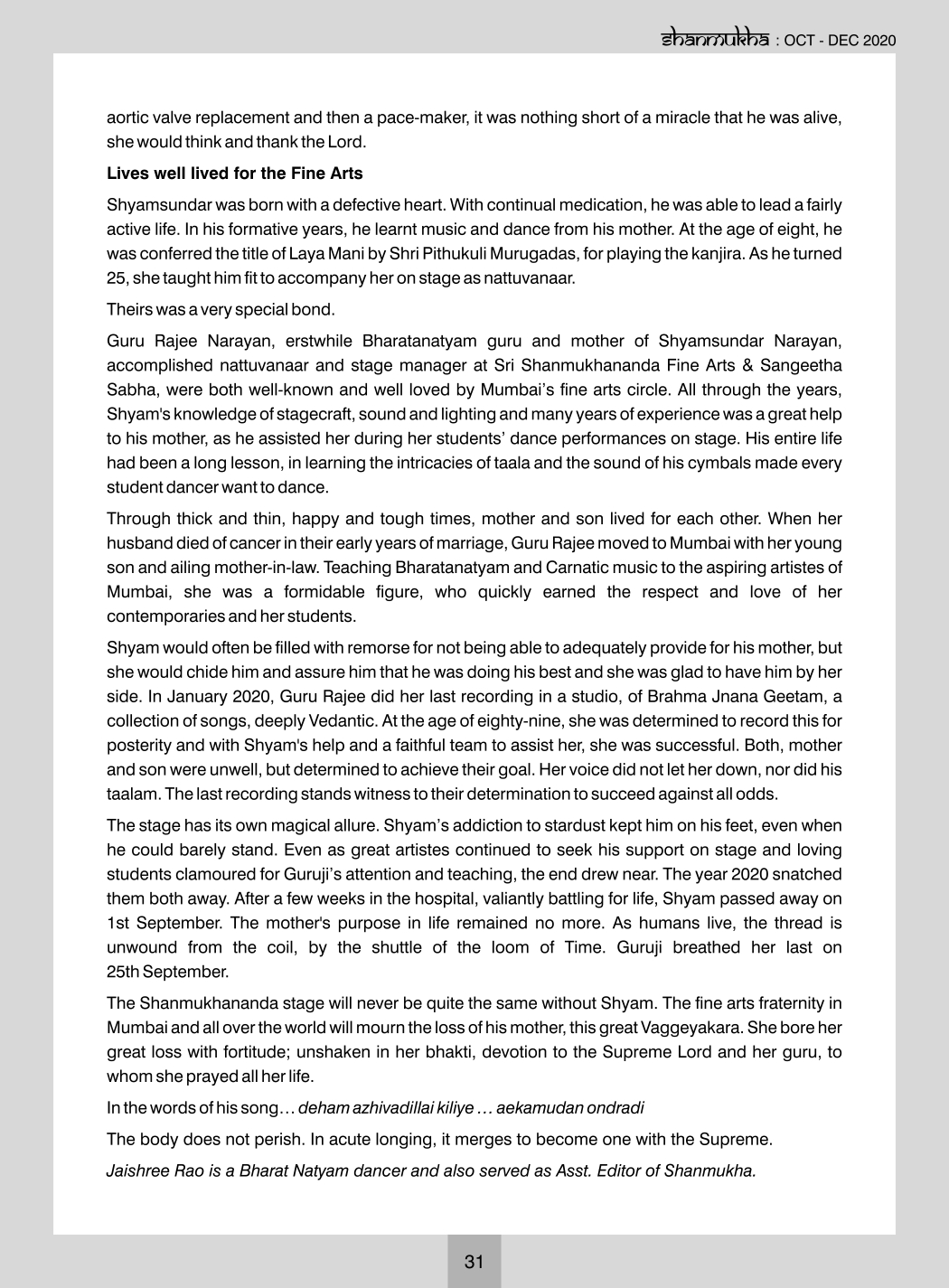
All the world’s a stage.

Courtesy: Shanmukha Cultural Journal of Sri Shanmukhananda, Fine Arts & Sangeetha Sabha – Mumbai,
October – December 2020

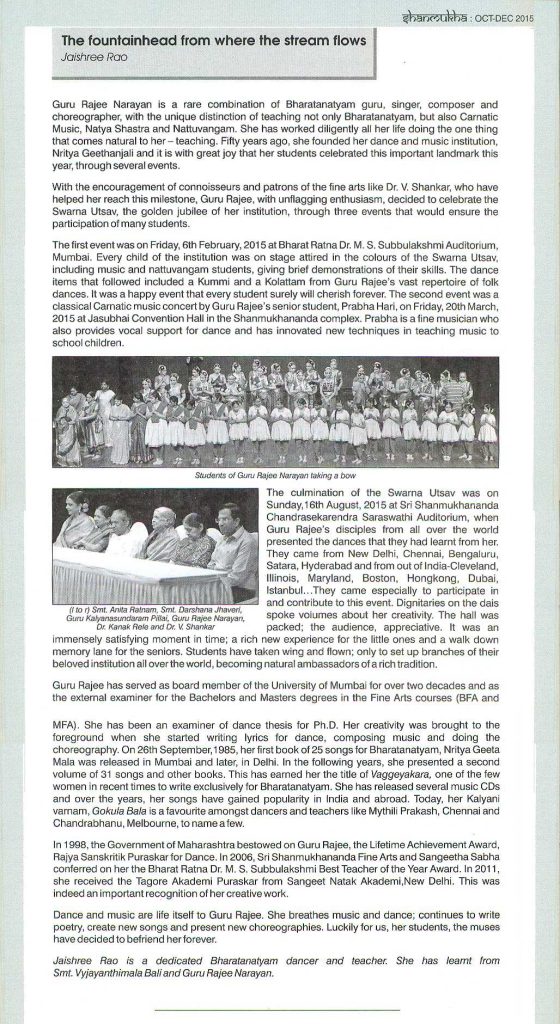
The Fountainhead from where the stream flows

Jaishree Rao – Shanmukha, a cultural journal – October – December 2015

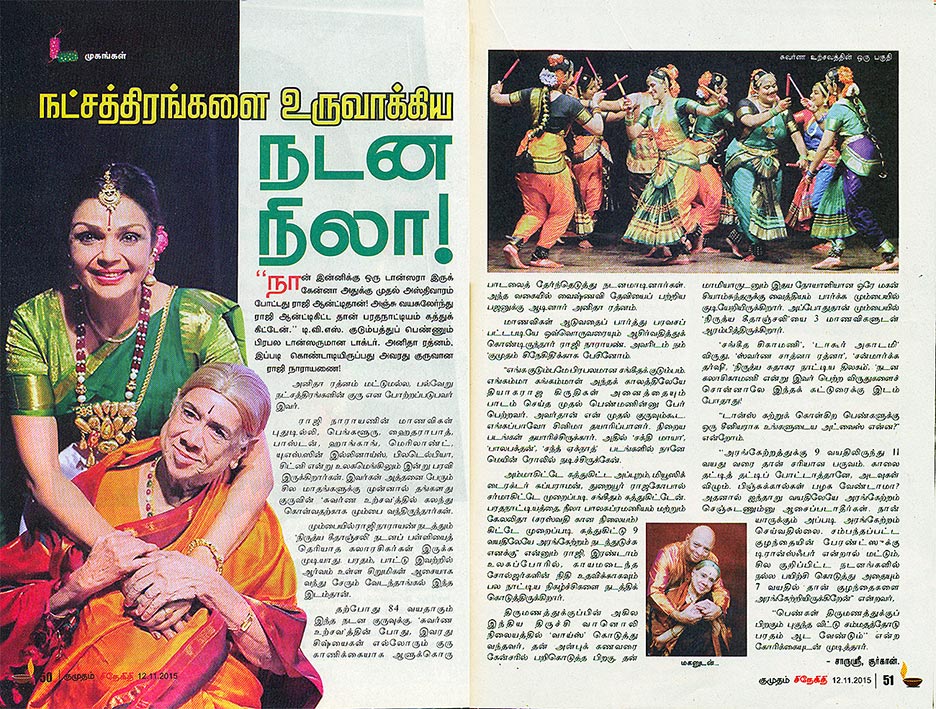
Natana Nila

Kumudam Snehidi 12.11.2015

Completing half a century of teaching

Manju Subash Chandran – Asian Age – Tuesday, 3rd February, 2015

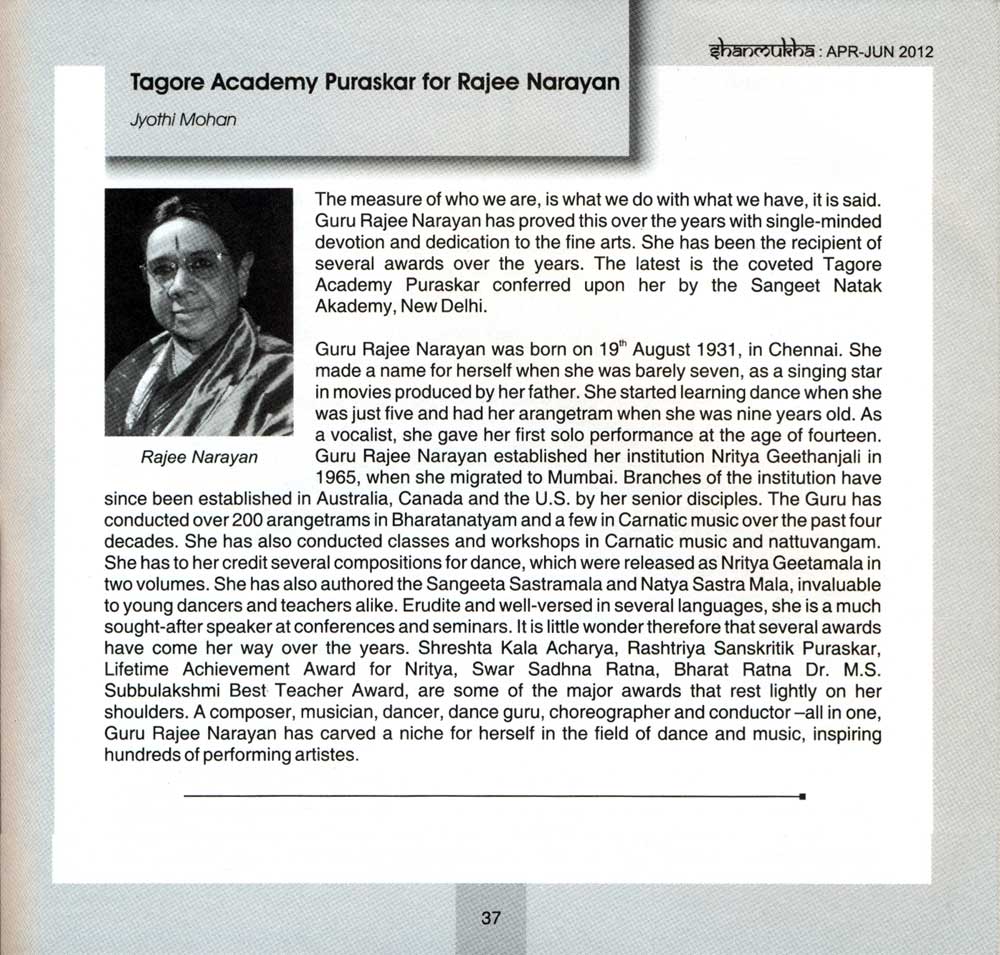
Tagore Academy Puraskar for Rajee Narayan

Jyothi Mohan – Shanmukha – A Cultural Journal – April – June 2012

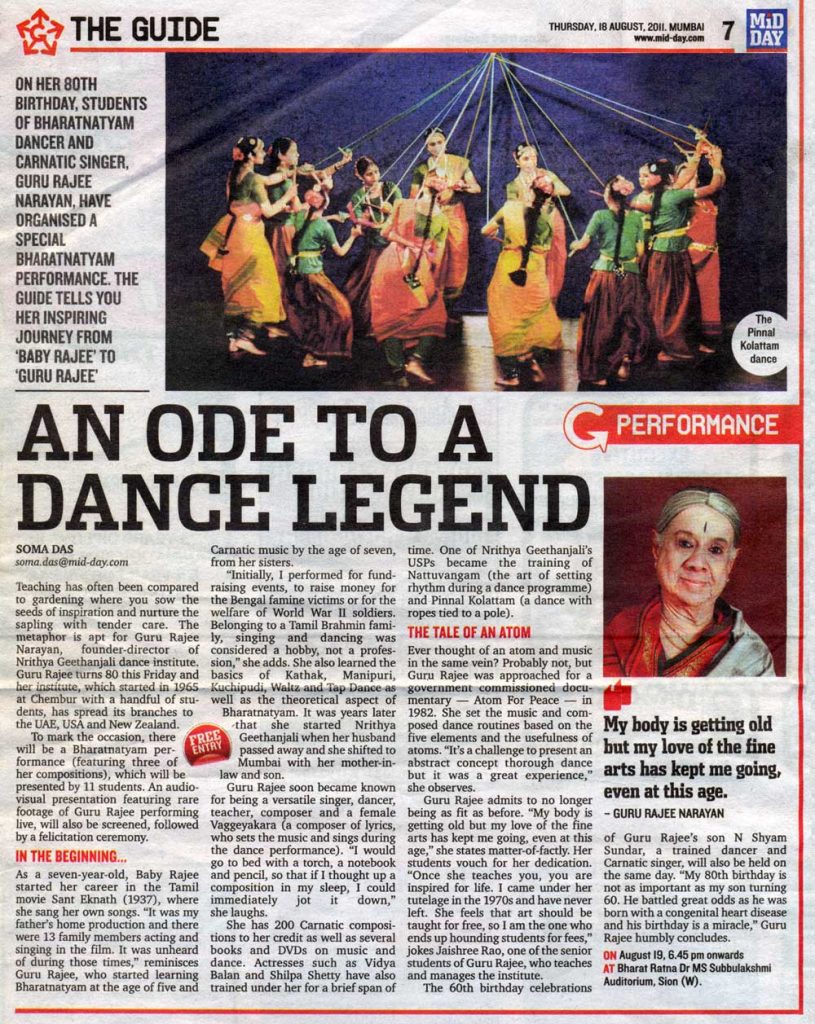
An ODE to a dance legend

Soma Das – MidDay – Thursday, 18 August, 2011, Mumbai

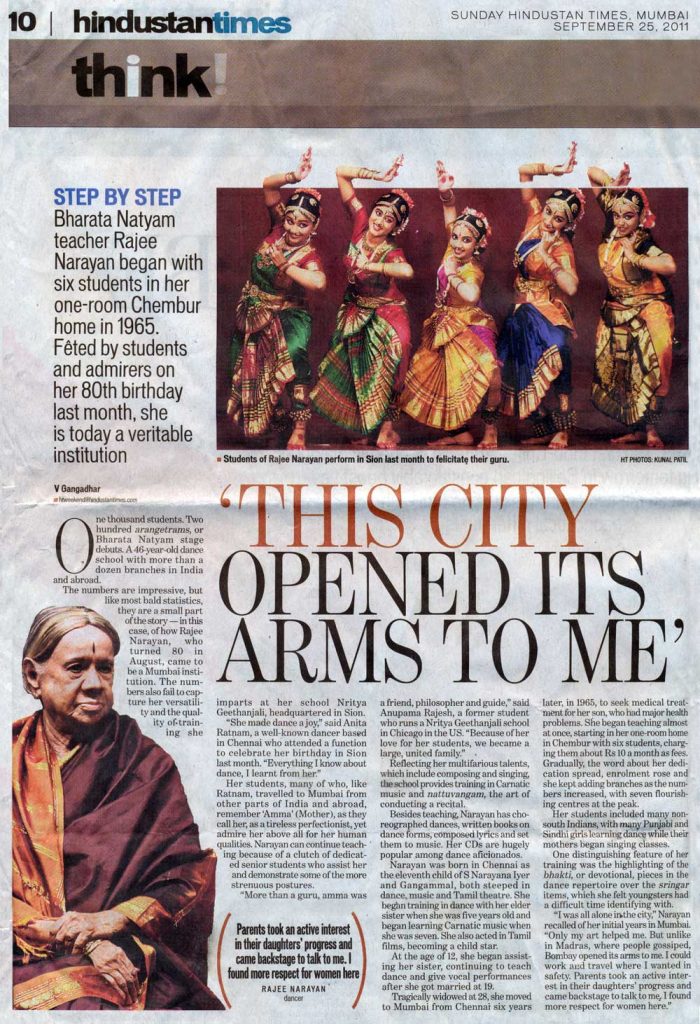
This city opened its arms to me

V. Gangadhar – Hindustan Times – Sunday, 25 September, 2011

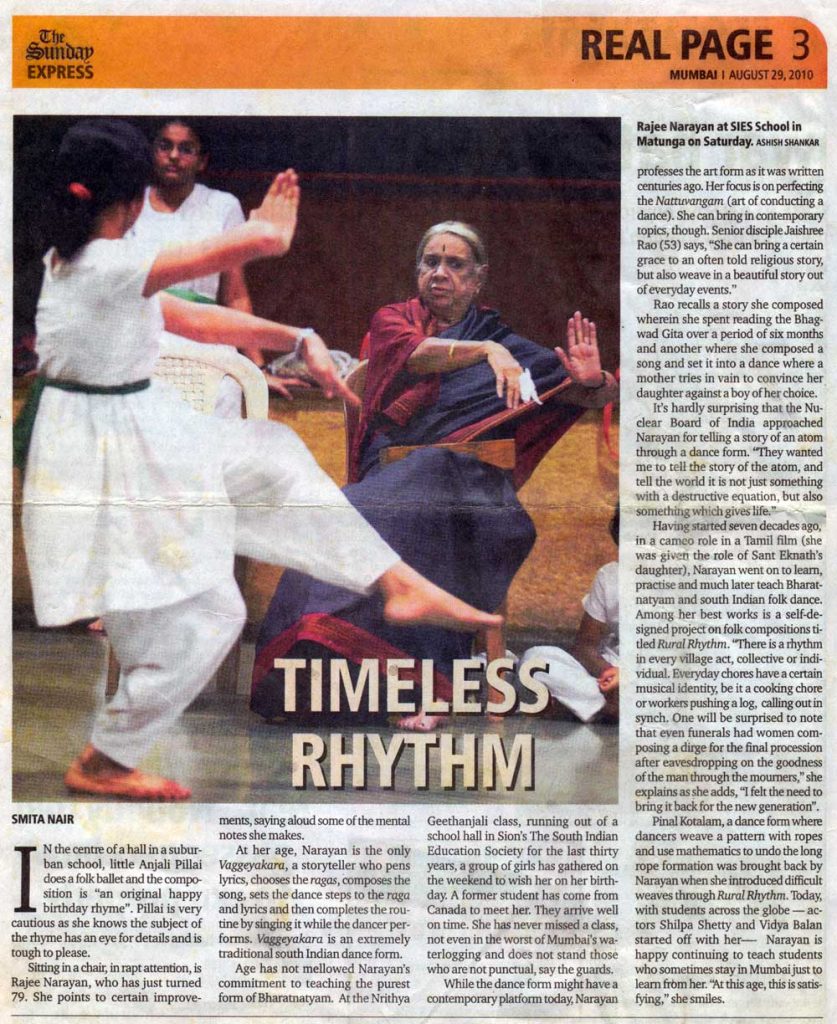
Timeless Rhythm

Smita Nair – The Sunday Express, 29 August, 2010, Mumbai

The Guru par Excellence

Mumbai Tamil Times, 24th August 2007

Nrityam 2005 – Performing Arts Festival in Mumbai

Nartanam – Oct-Dec 2005

Guru Rajee in conversation with Prakriti Bhaskar, Yamini & Guru Raja Reddy

Symposium on Dance Choreography in Mumbai

Sruti – April 2004

(Excerpt from an article in SRUTI – April 2004 issue)
…. Rajee Narayan is a senior Bharatanatyam teacher and her institution, Nritya Geethanjali is well known. She is a composer also with an abiding interest in music. She did not speak at the seminar. Her approach is so true to tradition that it has sometimes been labeled ‘provincial’. While she recognises that rhythm is important in the overall effect of dance, she uses it in moderation. Not very enthusiastic about lengthy jati-s even in the varnam and tillana, though she has composed a complicated jati in Mattiya tala, she finds long jati-s tire the dancer and the accompanist. What rhythm there is should be relevant, and to her, gender-friendly. For instance, choreographing the phrase ‘Sivakami aada’ she would rely on Lasya movements, whereas if it were about Siva, she would use forceful movements. She has found a gender difference in the choreography in that women teachers place greater emphasis on abhinaya, and men on technique and rhythm.
In Rajee Narayan’s view, choreography must be suited to the dancer’s abilities and strong points. In a group, roles must be assigned to suit individual abilities. The theme would depend on the venue and expected audience. In a temple, bhakti should be the rasa and the effect, one of self-absorption, but in an auditorium, many rasa-s will need to be depicted and outwardly communicated.
In this teacher’s strongly expressed view, traditions must be adhered to and sastra-s respected. Children growing up in today’s society need to understand the historical relevance of tradition in order to understand values of classical arts.

Vimala Sarma
April 2004. Sruti.

Composite Choreographer

Bombay Times – March 29, 2004

In performing arts, like in the Bharatanatyam, it is an unwritten law, rather a tacit underscoring, that a dance artiste is more perfect, if performing skill is augmented by a grooming in music. This especially in matters of abhinaya, when facial moods are etched on the sahitya (lyric) of the musical content.

In traditional Bharatanatyam, particularly, the Varnams and Padams deploy a lot of emotions. It is an added advantage to co-relate nritta and nritya with grace and pyrotechnics. An attempt of course to rejuvenate freshness in dance moments.

Mumbai-based dance Guru Rajee Narayan is one such rare blend. A Bharatanatyam performer in her hey-days with self-learnt musical intuitions in display. Rajee learnt through riyaz, even sang in musical evenings in her earlier Chennai days. A choreographer with rare insight for newer themes, she learnt under Guru K Lalitha. With sister Neela and a group of dance enthusiasts in the 50s, Rajee prepared herself for a sustained campaign to perform Bharatanatyam with zeal, even when dance was considered lowly for respectable Brahmin girls. It was done in association with lawyer-turned-dancer (late) E Krishna Iyer. Legendary artistes like Balasaraswathy and Rukmini Devi Arundale were prime motivators.

Rajee in her own humble style later established herself in Mumbai, teaching hundreds under Nritya Geethanjali. Rajee’s themes have veered to variant topics, from tradition-filled to trend-setting. She is the only lady ‘vaggeyakara’ (music composer) so far in the field. She is the recipient of the ‘Lifetime Achievement’ award from the Maharashtra Government in dance.

Bachu Vishwanath
March 29, 2004. Bombay Times – Kulchur Zone

Rajee Narayan – a Vageyyakara’s work in Books & CDs

KutcheriBuzz.com – Oct. 2001

In performing arts, like in the Bharatanatyam, it is an unwritten law, rather a tacit underscoring, that a dance artiste is more perfect, if performing skill is augmented by a grooming in music. This especially in matters of abhinaya, when facial moods are etched on the sahitya (lyric) of the musical content.

In traditional Bharatanatyam, particularly, the Varnams and Padams deploy a lot of emotions. It is an added advantage to co-relate nritta and nritya with grace and pyrotechnics. An attempt of course to rejuvenate freshness in dance moments.

Mumbai-based dance Guru Rajee Narayan is one such rare blend. A Bharatanatyam performer in her hey-days with self-learnt musical intuitions in display. Rajee learnt through riyaz, even sang in musical evenings in her earlier Chennai days. A choreographer with rare insight for newer themes, she learnt under Guru K Lalitha. With sister Neela and a group of dance enthusiasts in the 50s, Rajee prepared herself for a sustained campaign to perform Bharatanatyam with zeal, even when dance was considered lowly for respectable Brahmin girls. It was done in association with lawyer-turned-dancer (late) E Krishna Iyer. Legendary artistes like Balasaraswathy and Rukmini Devi Arundale were prime motivators.

Rajee in her own humble style later established herself in Mumbai, teaching hundreds under Nritya Geethanjali. Rajee’s themes have veered to variant topics, from tradition-filled to trend-setting. She is the only lady ‘vaggeyakara’ (music composer) so far in the field. She is the recipient of the ‘Lifetime Achievement’ award from the Maharashtra Government in dance.

Bachu Vishwanath
March 29, 2004. Bombay Times – Kulchur Zone

Rajee Narayan’s landmark creation

Afternoon Despatch & Courier – May 25, 2000

Fifty years ago, a dancer from the south attracted a large number of young girls to her classes in a small rooom. She earned them the reputation of being a talented, top-class teacher. Her dance school, Nritya Geethanjali became a centre of cultural happenings.

Rajee Narayan was however, not quite happy teaching the same old compositions day after day. As a creative person, she saw immense possibilities of enlarging the scope of the enchanting classical dance – Bharat Natyam.

What she did was a landmark performance in the history of Bharat Natyam. She started composing new songs and wrote them all down – songs to go with the movements of all the dances in the Bharat Natyam repetoire – from ‘Allaripu’ to ‘Thillana’. She must have taken great pains to finish the monumental work.

They are all now available in a book form. The first publication appeared 15 years ago. A new edition has just hit the stands. The name of the publication: ‘Nritya Geeta Mala’.

There is a wealth of information, useful guidelines for the new dancer or teacher. It is all there from word to word – from movement to movement – in fixed symbols, easy to understand and follow.

And what is quite creditable, it is in three languages – English, Hindi and Tamil. An American in New York or a dancer in London can follow the script and learn Bharat Natyam. The publication is partly financed by Sangeet Natak Academy.

It is the best ever guide to learning Bharat Natyam.

No wonder Rajee Narayan has been recipient of universal praise for her outstanding work. In the second volume, the additional 31 songs are published.

Rajee Narayan: “I have taken, enough care to see that the ‘raga’ and ‘tala’ are in sync with the mood of the songs expressed by the lyrics. In the new 31 numbers, one ‘jathiswaram’, one ‘sabdam’, seven ‘Varnam’, three ‘thillana’, seven ‘padam’ on Bhakti Bhava’, six ‘padam on Nayika bhava’, two ‘padam’ on ‘Nayaka bhava’ and one ‘Mangalam'”.

Finally, Rajee Narayan says: “I have done my work. It is now left to the Natyacharyas and performing artistes to utilise these songs to the fullest advantage.”

May 25, 2000. AFTERNOON DESPATCH & COURIER

Felicitations to Guru Rajee

Sruti – 1998

It was a matter of pride for all South Indians in general and those settled in Mumbai in particular, that the Government of Maharashtra had chosen to honour Guru Rajee Narayan with the Maharashtra Rajya Samskrutik Puraskar in the field of dance for 1996-1997. Though this lifetime achievement award was announced several months ago and was formally confered in April, only recently did the South Indians of Mumbai wake up to realise the significance of the award.

The Fine Arts Society, Chembur, stole a march over the other institutions in felicitating Rajee Narayan. In a function organised on 20 September, the Society presented her with a silver kuthuvilakku or the traditional oil lamp through the hands of the venerable natyacharya T. K. Mahalingam Pillai and a bouquet of flowers via Dr. Kanak Rele, the chief guests of the evening.

Instituted in 1976, the Rajya Samskrutik Award comprises a citation, a memento (a beautiful globe depicting India and Maharashtra, mounted on a pedestal with a small lamp) and 25,000 rupees in cash. There was a short spell of four years or so when the awards were discontinued before being re-instituted some 15 years ago.

The State cultural awards for lifetime acheivement in diverse categories, ranging from theatre to fold and classical arts, have always been given to Maharashtrians. The highest honour of the State received by Guru Rajee Narayan vindicates the contributions of all those of non-Maharashtrian origin who have made Mumbai and Maharashtra their home and who have become an intrinsic part of the city’s life and culture. As Kanak Rele said, culture transcends language and religion and anyone who has enriched the cultural life of the State ought to be recognised for his or her contribution. She said that, in her 30 years of association with Rajee Narayan, she has found her to be a very self-effacing person who never pushed herself to the front and hence very few people knew her great qualities.

Guru Mahalingam Pillai, who spoke of Rajee Narayan’s several achievements as a Bharatanatyam teacher, musician, composer and so on, drew particular attention to her work with the physically disabled children in presenting Nandanar Charitram a few years ago.

Rajee Narayan has been teaching Bharatanatyam and Carnatic music for over 45 years and can be counted amongst the handful who teach both these arts. She is also the only one in Mumbai to conduct classes for nattuvangam and many are those who have availed of her teaching. She has several compositions in several languages to her credit and is a choreographer also. She has two publicaions – Nritya Geeta Mala, consisting of two complete margam-s of her compositions for Bharatanatyam, and Natya Sastra Mala. A second volume of Nritya Geeta Mala with more of her compositions is on the anvil

Rajee Narayan established her institution Nritya Geethanjali in 1965, when she migrated to Mumbai. Branches of the institution have since been established in Australia, Canada and the U.S. headed by her disciples. In recognition of her knowledge and experience, she was appointed a member of the dance faculty of the Mumbai University, a post she has held for over 20 years. She has also been a paper-setter and examiner for the BFA and MFA courses of the University through the years.

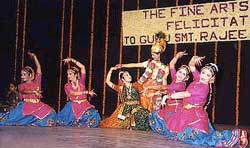
After the felicitation function, there was a solo recital by Rajee Narayan’s talented disciple Radhika Ramani who presented some of her guru’s compositions. This was followed by a ballet, Radhey ka Shyam, composed in Hindi by the guru and presented by some of her senior disciples.

What attracted many members of the audience, comprising other guru-s and aficionados, was the melodious singing of the first few phrases of the particular item by the dancers themselves. The dancers had been trained in Carnatic music also by Rajee Narayan.

The one jarring note in the proceedings was the announcement by the organisers that the others who had turned up to felicitate the guru on the occasion should do so backstage as they did not wish to delay the dance recital. When the evening had been announced as an event to felicitate a respected guru, it would have been only fair and gracious to let others (invitees all) to publicly express their appreciation. It is another thing altogether that a few managed to come up on stage and present their bouquets or shawls before the curtains closed on them. One hopes FAS will take note of this in future, for it has always displayed professionalism in conducting programmes.

K. Subadra Murthy 1998. Sruti

Senior students performing Radhey ka Shyam. Seen in the picture are (left to right) Asha, Mrudula, Anupama, Prabha & Lavanya

Rajee Narayan: with Natraja’s Blessing

Dignity Dialogue – Nov. 1998

‘Kalavani’, ‘Natya Nipuni’, ‘Natya Tilakam’, ‘Natanakala Bhushanam’, ‘Shrestrakala Acharya’ are some of the titles conferred on Rajee Narayan. A profile of this versatile danseuse and singer.

Rajee Narayan, awarded the Raj Kala Puraskar Anand by the Maharashtra Govt. in the field of dance for the year 1997, is a talented lady with real depth of knowledge in the field of Carnatic Music and Bharatanatyam. Right knowledge, right thinking and right action are the ingredients of her success in the rough and tough life dancers face. Courageous and persevering, she inspires practicality and self confidence amongst those whom she meets.

Born on August 19, 1931 at Madras as the 11th and youngest child of Srirangam S Narayana Iyer and Gangammal of Thiruvayur, Rajee was brought up by her sister. A family tale has it that Rajee’s mother was so fed up of bearing so many children that when Rajee was born, she left the 10-day old infant at the hospital telling the gynaecologist to bring her up and went home alone. After nearly a week, Rajee’s eldest sister, Neela Subrahmanyam was petrified when she discovered that the baby had been abandoned. She promptly went to the hospital and retrieved the infant.

Rajee’s eldest sister groomed her in her dance school Nataraja Natya Niketan at Chennai. She got her higher grade diploma in Carnatic Music from the Govt of Madras and advanced training from Sangit Vidwan Thuraiyur M Rajagopala Sarma. She underwent training in Bharatanatyam from K Lalita of Saraswati Gana Nilayam, Madras for a decade.

Rajee’s career as a perfoming artist actually started at the tender age of three, when she played the key role of ‘Bala Bhaktan’ in a movie. This was followed by two other film roles in the lead.

Rajee was married in 1950 to Narayan who was working in the Electricity Board at Madurai. She was blessed with a son; but unfortunately soon after the birth of their son Narayan died of cancer. For the young bride it was a great blow as she had hardly got over her shyness to enjoy the first blooming of romance in the old fashioned marriage.

She migrated to Mumbai in 1965 and set up the school Nritya Geethanjali teaching Carnatic music and Bharat Natyam. Rajee had conducted over 200 Arangetams in Bharat Natyam and six in Carnatic music over three decades!

She learnt light Hindustani music especially Bhajans and Abhangs. She also familiarised herself with Western classical dancing from a German lady. She has also regularly broadcast Carnatic music compositions over A.I.R. for nearly three decades.

Rajee has been imparting training in Nattuvangam for the past 20 years. Many of her students have become allrounders and are teaching in India and abroad.

An external examiner at Nalanda Nrityakala Mahavidyalaya for several years, she is a member of the Board of Studies at the University of Mumbai. She is also the external examiner at the M S University, Baroda.

She not only composes music for her dance songs but is also an accomplished lyricist. She has written and published two books: Nritya Geeta Mala and Natya Shastra Mala.

Rajee has choreographed
• Tinmayil Kuravanji
• Azhagar Kuravanji
• Parijalam
• Vallimaalai Kuravanji
• Sivaleela
• Krishnaleela
• Srikrishnamayam Jagat
• Mahakavi Bharati
• Timmungan Thiruvula

After intensive research Rajee presented Soundarya-lahari, Uttukadu Gamammtam, Bharatiya songs, Kolatta Jothari, Kummi and Haridarsa Nrityam (in Kannada language) in Bharatanatyam form. Mumbai Doordarshan has telecast many of her programmes.

Rajee trained mentally and physically handicapped children specially in a ballet called Sankara. Her choreography and music for the Nuclear Board of India’s Documentary Film “Atom for peace” occupies pride of place. This lady seems to be born with the exclusive blessings of Lord Nataraja!

‘Kalavani’, ‘Natya Nipuni’, ‘Natya Tilakam’, ‘Natanakala Bhushanam’, ‘Shrestrakala Acharya’ are some titles conferred on Rajee Narayan.

Even at 66 Rajee holds the audience spellbound when she sings on stage. Her powerful voice is very melodious. In one of her concerts when she rendered the song: “Naaradamuni Vedalina”, her rendering of the phrase – “Naaraayana Naamamulam Paaraayana Monainchuchu” — was so pleasing and divine with ‘Bhaki Rasa’ oozing that it transported the listeners really into the higher realms of life!

M. Vasantalakshmi
Nov. 1998. DIGINITY DIALOGUE

Rajee Narayan conducts class – 1975

Rajee Narayan bags award

The Navhind Times – June 26, 1998 Strikingly simple and the very epitome of dignity, Guru Rajee Narayan, clad in a fetching grey and red saree, welcomed me into her modest apartment in Sion, Mumbai. She smiled gently as I congratulated her on her recent accolade the, Rajya Kala Puraskar. The award was conferred on her by Dr. P.C. Alexander, Governor of Maharashtra, for excellence in the field of dance for the year 1997, recently. Born into a family where art is a way of life, it was only natural for her, to pursue a similar career. Her father Narayana Iyer was a poet, author and film-maker. Her mother Gangammal was an exponent of classical Carnatic music and was young Rajee’s first music teacher. Elder sister Neela, a danseuse from the Pandanallur school took young Rajee under her wing, therein marking the beginning of a life-long journey. After schooling in the Presentation Convent “Church Park” in Chennai, she obtained a diploma in Carnatic music from the Government of Madras. Further, perfecting the art form of Bharatanatyam, under the tutelage of K Lalitha, for more than a decade. Her tryst with the silver screen was rather early and brief. She played lead roles in Bala Bhaktan, Ekanthar and Sakti Maya and has also sung in them. It is notable that as a young artiste, she sang at her dance performances, a rare combination indeed. Nevertheless, her transition into a “guru” is the most significant aspect of her romance with the art. She plunged into teaching soon after marriage, however, she founded Nritya Geetanjali, her school in 1965 in Mumbai. She reminisces, “I felt the need to establish my own institution in order to create my own identity in a commercial city like Mumbai.” In her career as a guru, spanning nearly five decades she has conducted over 200 Arangetrams and her students in turn teach in India and abroad. She further imparts training in Natyashastra, the art of Nattuvangam and classical Carnatic music, vital to those students who take a deep interest in art. On experimentation with the classical form, she opines “experimentation is fine as long as the classicism of the art is not sacrificed, it must be supplemented by detailed research.” Rajee’s most poignant moment was during a performance in a camp for British and Indian soldiers, during the Second World War. She was deeply overwhelmed to see misty eyes among the wounded soldiers as she danced to a devotional piece dedicated to Lord Krishna. “I have no regrets, I want to continue to teach dance until the very end.” says Rajee with a serenity that is palpable. Going by her track record, it is certainly not wishful thinking. For the rest of her fraternity and most importantly, her audience, there is much in store from this one woman institution. Priya S. June 26, 1998. THE NAVHIND TIMES

Bharat Natyam is life for Rajee

Blitz – Jun. 20, 1998

Veteran dance teacher Guru Smt. Rajee Narayan is a latest recipient of the prestigious Maharashtra Rajya Sanskritik Puraskar (known as the lifetime achievement award), for her contribution towards the enrichment and propogation of Bharatanatyam for over five decades.

This is probably for the first time that a South Indian in the field of classical dance has won the award. Besides the exquisite trophy, Rajee Narayan also received a cheque for Rs. 25,000.

Rajee is the daughter of S. Narayana Iyer, who was a great vedic and yogic scholar writer and poet. Her mother, Gangammal, was recognised as the only family lady who knew the maximum number of Tyagaraja kritis, padams and javalis, and was Rajee’s first guru for Carnatic music.

Rajee had her schooling in the presentation Convent, Church Park, Madras and later she obtained higher grade diploma in Carnatic music from the government of Madras. She was the disciple of the veteran Thurayur M. Rajagopala Sarma and also gained insight into Hindustani music and specialised in Hindi bhajans and abhangs. She learnt Bharatanatyam from K. Lalitha of Saraswati Gana Nilayam for more than a decade and also studied other classical dances and got herself familiarised to Western classical dancing too.

A widow since ’59, her husband died of cancer. Six years later she left Chennai and came to Mumbai where she established Nritya Geethanjali. Rajee Narayan is possibly the only Guru who is also a linguist, having composed innumerable dance compositions in Marathi, Hindi and Tamil, all of which these have been published. Her latest Nritya Geeta Mala Vol II has been submitted to the Sangeet Natak Akademi for a grant and thereby Rajee has succeeded in widening the repetoire for Bharatanatyam.

Besides teaching natya sastra to students, Rajee has also had a fruitful association with Nalanda Nrityakala Mahavidyalaya for over 20 years as the external examiner for graduate and postgraduate courses and at the University of Mumbai as a member of the Board of Studies.

Mumbai Doordarshan recently invited her to present Krishna Leela in varnam format in Marathi language, and Sankara, a ballet in different languages with untouchability as the theme, was conducted with physically and mentally handicapped children for the I.S.R.H. at the Nehru Centre in Mumbai. When the Nuclear Board of India sent a documentary film titled Atom for Peace to Russia during the Festival of India, Rajee was asked to compose the music and choreograph the dance for their script.

“I am happy that the Maharashtra government has recognised my services,” admits Rajee Narayan. The other awards received by her are Kalavani, Natya Nipuni, Natya Tilakam, Natana Kala Bhushan and Shreshta Kala Acharya. Nevertheless, the award that is truly worth of her is the Sangeet Natak Akademi Award which should be bestowed on her very soon.

Vijay Shankar
June 20, 1998. Blitz.

Symbol of the CYMBALS

The Sunday Observer – Aug. 24, 1997

A recent workshop in Bombay concentrated on the art of conducting a classical dance recital and the importance of Nattuvangam in the dance context.

Even before the curtain rises for a dance programme, the mood is set by the mere sound of the cymbals striking together and provoking a resonance and a singular ambience.

And then the show starts.

Dance is a visual art – the pleasure of watching, the delight borne out of flowing nritta, or pure dance sequences, merging with vigorous movements and of course the use of expression as a language of communication. All through this melange, one synthesizing element is the reverberating sound of the cymbals – called talam in Bharatanatyam jargon – the skillful juxtaposition of two pieces of metal to produce the sound of dance.

The art of wielding this pair of cymbals so vital in dance, of effortlessly reeling out the syllables or the sollus, of guiding the dancer, of holding the reins, is the art of Nattuvangam.

A pivotal element in Bharatanatyam, as in Kuchipudi, Nattuvangam is an indispensable factor and rather the most exacting one. Interestingly, while dance in itself is an art that is taught, Nattuvangam has always remainded an art to be imbibed. The Nattuvangam workshop held recently in Bombay was an attempt to codify and formalise the teaching of Nattuvangam.

Rajee Narayan, Bharatanatyam guru of many years who conducted the workshop remarks, “In our days, we had to learn things the hard way: watching, absorbing, without asking questions. But in today’s world the modes of teaching have expanded, they are more liberal. In this set-up I thought of teaching Nattuvangam to eager students.”

The workshop went through the basics of tala shastra, the intricasies of rhythm, and took the students through the variations in speed and meter, the use of the stick called the tattu-kazhi and culminated with the use of the cymbals. It was an endeavour to systematize and organise the details that line the art of Nattuvangam, things that a person without sound grounding in Carnatic music and rhythm would have little access to.

The mastery over rhythm apart, Nattuvangam even otherwise is a specialized art. Masters of the past have imparted a special hue to this art by virtue of their skills. Veteran Bharatanatyam guru T. K. Mahalingam Pillai elaborates, “The Nattuvanar is required to have a grip over rhythm. He should be able to guide the recital. Moreover, the recitation of the sollus should be crystal clear and at the same time musical. This itself is an art.” Rajee Narayan adds, “Sometimes, students take a breath at the wrong moment, thereby elongating the rhythm structure, or swallow up a syllable. All this makes a large difference.”

Nattuvangam also involves sensing the global aesthetic effort of the recital and moulding oneself to it. Guru Pillai illustrates th point with a few examples made ornate with experience. “During the vigorous phases like a theermanam, the Nattuvngam has to complement it in force. Otherwise, for lyrical pieces like padams, it has to be softer, more gentle. It shouldn’t be monotonous and should blend with the piece presented.”

Eschewing monotony and synchronizing with the other musical instruments on stage demands hundred per cent alertness from the Nattuvanar. A slight lapse could make every thing go awry. Such is the role of the pair of seemingly simple cymbals.

Rajee Narayan makes another point of interest with respect to Nattuvangam. One has always spoken of the ‘Nattuvanar’, as the male doing the Nattuvangam. But there has in recent times been a change in role, with a lot of women wielding the cymbals. The change also signals knowledge breaking out of its bounds. And it is in this connection that the wokshop was significant; to attract the uninitiated, to sharpen the skills of the trained, and to open up vistas of curiosity and eagerness to the nuances of Nattuvangam.

K. Subadra Murthy 1998. Sruti

Guru Rajee (extreme left) conducting a nattuvangam workshop…. seen also in the picture are senior students Asha Krishna and Jaishree Rao

A balancing act

EXPRESS Newsline – June 12, 1997

The Nattuvanar blends talam beats and sholla with the dancer’s feet. A workshop in the city looks at his role.

The role of the vocalist is superior, followed by the instrumentalist and then the dancer – “Uttam gana, Madhyam bajana, Kanishtha nachna” – goes dance lore.

The logic is simple: the instrumentalist plays according to the song and the dancer follows the instrumentalist. But when it comes to a dance performance, roles are reversed. The dancer is of prime importance followed by the instrumentalist and then the vocalist.

In either case, the reins of a Bharatnatyam recital are a pair of cymbals ‘talam’ firmly placed in the hands of a Nattuvanar. The Nattuvanar wields these cymbals in synchronisation with the dancer’s feet while mouthing the intricate sholla (pure dance words). At the same time, the Nattuvanar guides the mridangam player and other instrumentalists and has a firm grip over the songs as well. And this balancing act is termed as Nattuvangam.

Due to the sheer complexity of the task, in most cases, it is the dancer’s guru or a senior dancer who is the Nattuvanar. This is also the reason that most dancer-performers are at a loss when it comes to nattuvangam. The ongoing Nattuvangam workshop at the Nehru Centre attempts to address just this issue.

The workshop is being conducted by veteran dance and music exponent Rajee Narayan. The Mumbai-based Narayan has been teaching Bharatnatyam and Carnatic music, the natyashastra and nattuvangam since 1925. Her institute Nritya Geethanjali, has branches all over Mumbai.

Narayan also conducts two year nattuvangam courses with classes held twice a week. Apart from her senior students, dancers from other institutions often attend these workshops. Says Narayan, “I would be wasting my time if I try teaching nattuvangam to all my students. I teach those who I feel are truly interested in pursuing the art seriously.”

Describing the talam (cymbals), she says, “The left cymbal is made of steel while the right is cast in bronze. A hindalium cymbal instead of the steel one, is available in the market, but this does not produce the same sound.” Good talams are hard to find and expensive as each of them is hand-cast. “A good talam should resonate for at least five seconds after it is struck,” she explains. In the present workshop, Narayan will be covering the basics of Talashastra, reciting shollas, playing the talam and tatta kuchi. Usually used during the training of dance, the tatta is a rectangular wooden block while a kuchi is a wooden stick. The kuchi is hit on the tatta to produce the beats.

Given the accurate hand-mouth co-ordination and experience required, nattuvangam cannot be learnt in just 10 or 12 days. So, the workshop at Nehru Centre will just be a brief introduction.

And, if the present workshop initiates a movement, a generation of expert Nattuvanars, may not be such a distant dream after all.

Manjiri Kalghatgi
June 12, 1997. EXPRESS Newsline

Guru Rajee Narayan explaining the finer points of dance

A tribute to a poet

Indian Express – Dec. 26, 1993

At a time when birth and death anniversaries of great sons of India are being observed almost every other day, the death anniversary of Mahakavi Subrahmanya Bharati went almost unnoticed, early this month. But for the pupils of Nritya Geethanjali Dance Academy who presented a dance-drama on the poet recently at the Tata Theatre.

For the Academy’s founder-director Guru Rajee Narayan, “It was a dream come true. I had had my fill of dance-dramas based on mythology and those culled from the puranas and Ithihasas.”

Poet Subramanya Bharati was a visionary far ahead of his times who left an indelible stamp on every phase of life. There was no subject, no theme or mood he had not enriched by his songs and no emotion he left unravelled. He composed songs and poems on every facet of life depicting the trials and tribulations, the ups and downs one confronted in all walks of life – socio-economic, political and cultural – and bringing in classical folk melodies in close coordination.

“To project the multi-faceted life of this versatile poet,” says the Guru, “was my original idea. But reading all the books I had collected on him and the songs he had composed I found that whilst his songs are very fluent and smooth the story of his life isn’t. Not a ‘presentable’ picture. Full of thorns, it was also not sufficient enough as a suject for a dance-drama. Grooping for a while I seized on the idea of depicting him through his songs and sought his grandaughter Lalitha Bharathi’s help. Her narration of incidents which inspired him into penning songs on various subjects like awakening the men to their rights and duties, the women to their liberation and inspiring children to better life, fuelled my imagination. Each song, each incident however apparently trivial, had a message. Sugar coated and clothed in pleasant melody, the message was ideal for reaching all corners. A new depth, a new dimension dawned to turn my dream into a reality.”

Continuing, the Guru explained how she tried to bring in the Bharati household, the couple and their two daughters in an introductory facet of each scene of the drama and let the personages of the songs take over the visualisation through dance. That way, a personal touch to the poet’s domestic life was given. A dialogue between the Bharati couple, the wife playing quite an important role, inspiring him with ideas enlarging his vision, was the Guru’s choreographic contrivance. And the actual drama in the Guru’s words unfolded itself through “the manipulation of lighting”. She let the life of the Mahakavi flow in dance, delivering the song’s message. To encapsulate the epic proportion of the kavi’s mesage in a two-hour production, called for a great deal of work.

The recital starting with a Prarthanai (prayer) weaves through ten scenes covering the poet’s household and family dotted with significant events in his life, viz. awakening the masses to the greatness of Bharatmata and need for eschewing caste and religious differences, his self-imposed exile in Pondicherry (to evade arrest by the British Raj) and his subsequent return, his compositions on our epics – Kannan Paattu and Panchali Sabadam his patriotic outpourings and finally his exhortation to his countrymen to fight for freedom, as he lay dying after being attacked by a temple elephant.

The vision of the Guru visualising the messages of the Mahakavi was laudable, the selection of songs, the links provided for the storyline apt and the choreography weaving through classical and folk idioms and with suggestive links of the margam, gave the required pep. Music with original tune for introduction and popular melodies for visual enunciation, added appeal and authencity. Sartorical relevance was another plus point. Among the case, little Krishna stole the show. The dances on patriotism and national integration were well done.

Sulochana Rajendran
December 26, 1993. Indian Express, Bombay.

Commendable effort

The Times of India – June 03, 1993

Mahakavi Subramanya Bharati: dance drama
Nritya Geethanjali Dance Academy
NCPA, Tata theatre, December 8

The very name Mahakavi Bharati conjures up the image of the fiery poet of Tamil Nadu whose prolific compositions range from patriotic songs to themes like women’s lib, from the devotional to the romantic. His exquisite lyrics have the power to rouse deep emotions.

Though some of the more popular compositions have found their way into the Bharatanatyam repertoire, and his centenary had brought out full length recitals of his compositions, this is perhaps the first time an attempt has been made to sketch his life in a full-length dance drama. Generally, dance dramas are based in epics, but Guru Rajee Narayan has conceived and adapted this contemporary theme of Bharati’s life in the traditional Bharatanatyam style with considerable success.

Choreographed and directed by the guru who has also composed the lyrics that link Bharati’s own compositions, the ballet brought alive Mahakavi Bharati’s unique poetry. The students of Nritya Geethanjali, from tiny tots, like Maya and Shailaja, to the senior most, Bhavani and Mala, have put forth a commendable show.

The tale begins with Bharati composing an invocatory song on the Hindu pantheon of Gods. His affection for his daughters, his patriotic out pourings, his flight and return from Pondicherry, his romantic instincts, the different facets of Krishna as seen by him – as a naughty child, a model servant, lover and a protector, were all touched upon in a fascinating blend, using purely classical and folk styles, such as Kummi, Karagam, Kollatam, etc. Though the costume changes were effected speedily and the time lapse between scenes was minimal, there were a couple of occasions where the slightly longer gaps could have been covered with musical interludes.

Anupama and V. Deepa in Suttu vizhi Sudardan deserve special mention as also Jatinder Singh Bansal in his lively roles, like the Kudu Kuduppandi

Bharati is shown singing the opening lines of some of his poems, the scene then shifts to some dancers in the corresponding roles dancing to bring out the evocative beauty of the compositions. Chinnanchiru kiliye, Theerada Vilayattu Pillai, Kanavu Kandadile and Panchali sabadam are just some of the more fascinating numbers.

Guru Rajee Narayan is reputed for her excellent choreography and the painstaking training she gives her students. This ballet has proved it once again. Though Vijaya as Bharati should project more masculinity to be more effective. The support from the wings with Shyamsunder singing some of the songs enhanced the overall effect.

K. Subadra Murthy
December 16, 1993. The Times of India, Bombay

Polished gems

The Times of India – Dec. 16, 1993

The Kala Bharati of the Karnatak Sangh featured for the first time, a Carnatic vocal concert by Rajee Narayan the well known dance guru. Though an accomplished singer, a disciple of the veteran Thurayur Rajagopala Sarma, it is rare that one has the opportunity to listen to her in a music concert.

It was a morning of melodies for music lovers, as Guru Rajee’s voice ranged mellifluously with cascading brighas infused with bhava. A vaggeyakara herself, she sang with understanding of the innate bhava of the kriti. Her erudition and creativity were in ample evidence in the raag expositions, excellent niraval and intricate swara combinations. A well chosen, multilingual repertoire was, like the organiser mentioned, in keeping with the spirit of national integration that Kala Bharati stands for.

While each piece was a polished gem, Thyagaraja’s ‘Mee valla’ (Kapi) and Dikshitar’s ‘Subramanyaya namaste’ (Kamboji) were a class apart with exquisite alaps that brought out the raag swarups beautifully, the niraval and kalpanaswaras adding embellishments to the well rendered kritis. She concluded with one of her own compositions ‘Velane’ in ragamalika followed by a Meera bhajan and an abhang. Anantaraman on the violin gave excellent support as also young Shyamsunder on the mridangam.

K. Subadra Murthy
December 16, 1993. The Times of India, Bombay

For Performers and connoiseurs

The Times of India – April 08, 1993

There are innumerable books on the ‘Natya Sastra’, erudite treatises that would gladden the heart of the connoisseur and the serious student and quite expensive to boot. There are also versions which are much simpler. But students of classical dance, who wished to be initiated into various aspects of ‘Natya Sastra’ without being overwhelmed by scholastic bombast had no book to refer to.

Such a student or a lay person with more that a passing interest in dance can now find what they are looking for in the ‘Natya Sastra Mala’, a compilation of lectures on the basics of ‘Natya Sastra’ in English by Guru Smt. Rajee Narayan published by Jaishree Rao.

An erudite natyacharya of Bombay, who had some years ago published the well acclaimed ‘Nritya Geeta Mala’ – a book of dance songs composed by her, Guru Rajee Narayan has delved into various sources to bring out the essence of the ‘Natya Sastra’ and present it in a simple and interesting manner.

Tracing the origin of dance with brief references to the literary works which give relevant information, she goes on to abhinaya the different bhedas like sirobheda, dhristibheda, nayikabheda. Listing the 108 karanas, she goes on to explain the various rasas including a separate chapter on Bhakti, the nava vidha bhakti and concludes with the margam of Bharat Natyam.

Apart from illustrations of the hasta mudras, the guru has also given the relevant slokas in Devanagari. Simple but elegant, the printing is of good quality. This handy guide to a dance student is priced at Rs 150 and is available with the author at Nritya Geethanjali Dance Academy, Bombay-22.

K. Subadra Murthy
April 08, 1993. The Times of India, Bombay.
</p

Celebrating Dance

Bombay – Sep. 22 – Oct 06, 1990

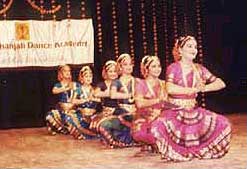
The last day of August was an emotion-charged one for Bharatanatyam Guru Rajee Narayan. For she was celebrating the silver jubilee of her Nritya Geethanjali Dance Academy, with a special show at the Nehru Centre Auditorium. Every student of hers – even the tiniest little greenhorn – got to be on stage at some point during the evening, as also some old students.

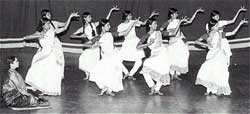
Students of Nritya Geethanjali performing at the Silver jubilee function of their institute. Seen in picture are Jaishree Rao, Saraswathy Lapsia, late Srilata Konduri, Shanti Parsuram, Mala Murli & Bhavani Krishnakumar.

Many of the items performed had been composed by the guru herself, and two such pieces, a tillana and a composition on the Krishna theme, were particularly memorable. Also, the guru took centrestage herself halfway through the show, to pay a prolonged, gracefully articulated vote of thanks to all the people who had helped her build her career – from the family that rented her a place to stay in when she first arrived here as a young widow with a little child, to all the parents of her students.

Sept 22 – Oct 6, 1990. Bombay
pra_celebrating_dance


Nritya Geethanjali: dedicated and disciplined

Free Press Journal – Sept. 05, 1990

Sulochana Rajendran traces the development of ‘Nritya Geethanjali’, an institution of dance and music which celebrated its silver jubilee recently.

Nritya Geethanjali, an institution of dance and music has made long strides and carved a niche for itself in the cultural map of this metropolis. To its founder-director, Guru Smt. Rajee Narayan it was not an easy march ahead. The ‘fighter-achiever’ that she is, well equipped in technique and trends of arts and with a zest for facelifts and innovations coupled with imagination and intelligence, Rajee persevered and succeeded in her pursuits, adding to her role while at the same time she strengthened the institution in various aspects of the performing art.

The silver jubilee of Nritya Geethanjali celebrated on August 29 at the Nehru Centre, would speak volumes of the toil and truimph of the Guru who is not merely a revered teacher but an affectionate ‘aunty’ to the multitude of her students. The spirit of dedication and discipline, the eclat of participation that she has instilled into her students were evident from the smooth and orderly flow of the celebrations. Everything was fine tuned, even the tiny tots with eager anticipation were gracefully quiet, not letting out even a whisper! And on the stage we had a cameo of dances, a variety of presentations, some purely traditional adhering to classical tenets, a few action songs by beginners, a couple of mini ballet by seniors, a Nama Kirtan reminiscing the bhajana tradition and a tight kit Tillana plus a ‘Pinnal Kolattam’ that is something more than a mere folk pastime – all these from the family heirloom.

All this speaks for the artistic family that Rajee hails from and her own achievements as a composer, besides being a musician, dancer, dance guru, choreographer and conductor all rolled into one. Right from her infancy she has been exposed to the world of art. She was born into a house of Iyal-Isai-Natakam (Literature, music, dance-drama). Her parents, sisters and brothers – eleven of them – were all talented and displayed it in one field or the other. More than this they pursued their chosen fields. Little wonder that the youngest of them, Rajee turned more versatile having been showered with blessings and knowledge from the elders in her family.

Availing of the opportunities as well as of intense training under teachers of eminence, Rajee emerged as a performer – teacher; and adding her own imagination and creative impulse she has taken her dream come true ‘Nritya Geethanjali’ to its 25th milestone.

That Rajee’s work, ‘Nritya Geetha Mala’ is a cherished treasure goes without saying. It contains guidelines not only to Nattuvangam but to choreography too with notes and notations in three languages. There is a Tala variety, Nayika variations, invocatory shaityas and intricate pure dance numbers like Jatiswaram and Tillana. The Varnams leave a colourful aura both in scope of sancharis and stances of rhythm. It is also a musicians pleasure as mere musical rendering evokes the bhava fused in its lyrics and musical setting. A few of them presented at the silver Jubilee Fete deserve mention.

“Paripaalayamam Sri Sambho Mahadeva” in soothing strains of Suddha Dhanyasi had the right blend of Tandava and Lasya, which uphold the concept of Ardhanareeswara.

“Velane Mukkannan Aruliya Baalane” (Ragamalika) was an apt choice for a mini ballet both in solo and multi character presentation. Made into a costume ballet, it captured the attention of many in the audience who were not familiar with the southern story line. Typical of the northern scenario was Krishna leela, depicting the eternal love of Radha and Krishna not before entangling them in a lovers’ tiff. While Radha’s agony, anger and final surrender were all familiar Nayika presentation Krishna’s viraha, pining for Radha was imaginatively touched upon and finely etched. The whole musical setting in Hindustani melodies not only revealed environmental perceptivity but also clothed the lyrics in Hindi. Special mention must be made of the renderings by the vocalists with the Guru leading, more particularly Rajee’s niece Neeraja who stood for her voice blend.

The specially composed Tillana a ‘Raga-Tala-Gatimalika’ much in line with Balamuralikrishna’s creations, had its own novelty, attraction and was performed with alacrity.

Presided over by Nana Chudasama, that champion of Service organisations, the programme was an eye filling event.

Sept. 05, 1990. Free Press Journal


A guru in two disciplines

Indian Express – Aug. 28, 1990

Rajee Narayan is perhaps the only guru who’s equally at ease with both music and dance. She’s been teaching both at her Nritya Geethanjali Academy in Bombay for the past 25 years. Kinnari profiles this unique combination of talents.

Nritya Geethanjali, a music and dance academy in this metropolis, turns 25 on 29 August. A colourful feast for the eyes awaits the Bombay rasikas.

Rajee Narayan’s story might seem like a fairy tale but it is very much a saga of sweat and tears. It is the story of one born and cradled amidst a musical environment and exposed to art even as a child to emerge an outstanding artiste-teacher-choreographer-conductor and composer, all rolled into one, keeping with the times and trends and yet not compromising on the traditional values of art.

Nritya Geethajali, for a Bombayite presents the rare academy of music and dance under one roof and one teacher. It has to its credit a Nattuvangam training course and a publication of dance margams, Nritya Geetha Mala, that has proved to be more than a handbook and guide in the practical enunciations, choreography, etc. to students and teachers of this art form. Besides quite some numbers of commemorative dance presentations dedicated to doyen-composers plus dance-dramas such as Uthukkadu Ganamritham, Bharati Paamaalai, Gejje Uilivu, Shiva Leela and Krishna Leela choreographed to Marathi lyrics come to one’s mind, not to speak of the mini classical-folk blend ballets like Parijatham and Kolattam Jotrai.

Born the last of eleven children to Narayan Iyer and Gangammal, Rajee was brought up on fine arts even before she could learn the alphabets. Her home could be called a living art emporium – sisters Neela, specialising in Bharatanatyam and Sulochana, in music, brothers in dramatics and dance, father a lyricist-poet producing his own drama with an all family cast and mother, though an orthodox housewife was a musician in her own right, singing for Harikatha of Cuddapah Lakshmi Ammal, a well-known figure in the cultural renaissance.

Skipping the basic lessons little Rajee straightway started with keertaas from her mother and the dance numbers from sister. Those were the days when “dancers were few and opportunities many” to quote her. “Children from respectable families were actually drawn into the art form and invited to perform at weddings and social functions, the sabhas being very few then”, she says.

With all the training at home and encouragement from without, she cut her first disc at four singing Muthiah Bhagavathar’s “Ikanataala jaalanuraa” (Hari-kambhoji) and “Neraminchi” (Shankarabharanam), a Garbhapuri composition. She also had opportunities to dance, especially for War fund campaigns. Her intensive coaching in music took off in her teens, from her sister Sulochana Mahadevan and later Turaiyur Rajagopala Sarma and in dance from sister Neela Balasubramaniam and Smt. Lalitha of Saraswati Gana Nilayam. Rajee had a stint of learning the piano as well for a couple of years and Western dance while a student of Church Park Convent, Madras.

Though her stay in Madurai in the Fifties was short due to the untimely death of her husband, Rajee received, many laurels on the concert platform. Her association then with the erudite composer Ambujam Krishna stimulated the composer in her and probably sowed the seeds of her Nritya Geeta mala.

In between attending to an ailing husband, she also managed her music concerts both classical and light classical. Playback singing and AIR broadcasts were also included. But after her husband’s death music became her very life. Only the priorities shifted from concerts to classes, to which she added the teaching of dance as well.

There is no specific bani (school) one can attribute Rajee’s dance to. “I follow mostly Tanjavur style that Lalitha taught me though I cannot do away with Pandanallur stances which had got into my blood stream having learnt my early lessons from my sister Neela”, says Rajee. “And I am not averse to other styles as I was exposed to Oriental dances which were the rage when I came on the scene. I do occasionally borrow stances from them for my costume plays and make slight concessions in choreographing bhajans in classical format.”

What brought her to distant Bombay?? “Certainly not any fascinations as such, but for my son’s future and for having an institution of my own, my dream for long,” says Rajee. Though offers came her way in Madras, too, especially from the industrial house of TVS, she did not want to set up an additional institution parallel to that of her sister’s or her guru’s. The need for a school of dance and music under one roof and the necessity for a livelihood for her made Bombay her new home. “But earning a livelihood”, she hastens to add, “has not deviated me from my convictions and principles.” On no account was she prepared to compromise on her art. An instance is the Nattuvangam course; true she teaches the students the basics right from the alphabets and trains them to wield the cymbals but not before an exacting test and a hundred per cent perfect score in that. For, in rhythm there can be no relative grading, either it is right on the dot or it is not.

The release of Nritya Geetha Mala in 1985 has sure been a milestone in the career of Rajee Narayan, for there is no composite song book that is almost a ‘dance in print’. What inspired her into this venture? “Two factors impelled me into the venture.” Rajee observes. “First, my own thirst for choreographing new songs, ones which had not been handled earlier. My attempts were well received and my efforts appreciated by gurus and critics and I took courage to widen my horizon composing songs varnams in rare talas, based on traditional themes but with my ideas. Second, the need of the day, especially for the new entrants who had got into the teaching line without being fully equipped for it and who sought my advice for songs, books and guidance. It was not for me to decide whether they were fit to be teachers or not. I felt like helping them.” And thus was born Nritya Geetha Mala with 25 songs in Tamil, English and Devanagari scripts with meaning, notation, tala counts, Jati variations, solkattu korvais, etc.

Hailed both by dancers and dance teachers, the book fulfills the musical requirements and applies to visualising technique, too. “The music and lyrics had the approbation of Sangita Kalanidhi K. S. Narayanaswamy who had advised me to use certain ragas and Kalaimamani T. K. Mahalingam Pillai spontaneously did abhinaya when I sang a few pieces for him and this is more than a blessing to me.” says Guru Rajee Narayan who has just entered her sixtieth year.

The real blessing is a guru like Rajee Narayan, an anachronism in this age.

28th August, 1990. Indian Express


Impressive Folk Fare

Indian Express – June 16, 1990

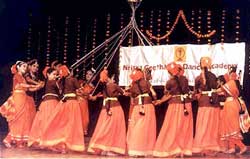
The folk dance recital of Kolatta Jothrai presented under the direction of Guru Rajee Narayan on Tuesday was a brave effort at reviving the Kolattam group of Tamil dances.

Traditionally, the Kolatta Jothrai festival is associated with the October/November harvesting season in Kartika. After sowing paddy, millet and red gram the women sing and dance for the next few days. The womenfolk dance kummis, kolattams and the pinal kolattam during the festival.

Rajee Narayan and her troupe remained true to the traditions in presentation, starting off with the pashu kolattam – a form of the kolattam dedicated to Kamadhenu the celestial cow of plenty. This dance with sticks was followed by a charitram kummi, abhinaya kolattam, a kummi with jatis (like Bharatanatyam), kuditta mar kolattam, with the pinals bringing up the rear.

Of the items in view, the pinal kolattams (pinals) were the best performed. Inspite of the intricacies of the braiding in this dance, which must be accompanied by rhythmic dancing with the kols (sticks), the girls displayed clarity and flawless rhythm. However, there was poor synchronisation in the payinda kolattam, which was the third item of the evening.

Inspite of their training in Bharat Natyam, the kummi with jatis showed some uncertainty in the classical movements.

An innovation of the kolattam, the Abhinaya kolattam combined small passages of abhinaya (classical expressive dancing) alternating with the kolattam stretches. The abhinaya part was very lively. Besides, the kolattams that traced tradition kolam-inspired linear patterns – varimara and kuditta mar – showed the kind of harmony in movement which is the hallmark of folk dance form.

Rina Mukherji
June 16, 1990. Indian Express


Dancing Disability Away

Bombay – Feb. 22 – Mar. 06, 1990

A group of bright-faced, colourfully dressed young girls comes on stage and does a perfectly coordinated Bharatanatyam piece. The grace of movement and facility with facial expression of the girls cannot be faulted; especially since none of them have had any previous classical dance training whatsoever. The girls glide off stage, more children do various folk dances on the celebration of rural festivals. The dancers’ rhythm and synchronisation rarely falter – or at least, no more than normal.

But by now, the viewer has realised that something about this performance is a trifle different from most others. For one thing, two girls in bright Kanjeevaram saris are standing discreetly, but noticeably at each corner at the front of the stage, facing the dancers. Using signs to indicate the various movements, they are marking the beat with their fingers. When the karagam and kummi dancers come on stage, one sees that most of the children have large, heavy callipers binding their little legs. One realises that all the children are handicapped, in one way or another. They are performing a dance ballet, Sankara, at the Nehru Centre Auditorium, under the auspices of the Indian Society for the Rehabilitation of the Handicapped (ISRH), a voluntary support organisation that aids handicapped individuals and organisations that work for them.

Of course, a production of this sort, however effortless it may appear at the end, means a lot of hard work. The storyline and the script, were ready by July and tells the tale of Adi Sankara. Little Sankara, who belongs to an orthodox Brahmin family is saved from drowning by the untouchable Adi. When Sankara (played by Raju) is disturbed at being touched by Adi (Abhijit), his mother (Meera) consoles him with stories from the past that demonstrates the meaninglessness of the caste system. After July, Guru Rajee Narayan took over. Choreographing done, the guru and four of her senior students, Deepa and Vidya Narayan, Kesari Rao and Mala Subrahmaniam (who also provides female voiceovers), took on the painstaking job of training the children. The result is unique not only in that it is rare for so many categories of the handicapped to perform together, but that it isn’t often that care is taken to extract such a thoroughly professional effort.

And professional the performers clearly are. After one has got over the initial heartbreak of watching little ones fling their callipered legs up in joyous, rhythmic abandon, the fact of the performers’ disabilities becomes irrelevant. What remains is the grace, the involvement and sincerity, the real depth of feeling that the children put into the performance. And their presence of mind could cause many veteran performers envy. One little boy whose new special shoes skidded on the freshly polished stage, flinging him flat on the floor, got up quickly without a change of expression and continued dancing vigorously. Their awarness of their own handicaps makes them very sensitive to those of others too, the organisers have noticed. In the Ramayana production when a blind Sita falling at Rama’s feet, landed slightly off-position, the deaf-mute Rama slid imperceptibly along the stage till he was directly in front of her.

The opportunity to work with and even help others has brought many of the participants out of their own cocoons of bitterness or self-pity. They have learnt to relate to and trust society at large. Meena Bhat, a sufferer of Down’s Syndrome who does brilliant rendering of a rich, unfeeling zamindar in Sankara, used to be “such an introvert, so uncommunicative” earlier, Narayan remembers. Now she is tremendously self-assured.

The production, which has cost about Rs. 1.5 lakh so far, may be repeated in a couple of months; potential sponsors have even offered to help take it on the road. And for the 30 to 50 individuals participating in this, and other similar productions, as well as for those training them, or viewing them, life is perhaps a little more meaningful afterwards.

Feb 22 – Mar 06, 1990. Bombay


With Love and Sympathy

The Times of India – Feb. 10, 1990

A group of bright-faced, colourfully dressed young girls comes on stage and does a perfectly coordinated Bharatanatyam piece. The grace of movement and facility with facial expression of the girls cannot be faulted; especially since none of them have had any previous classical dance training whatsoever. The girls glide off stage, more children do various folk dances on the celebration of rural festivals. The dancers’ rhythm and synchronisation rarely falter – or at least, no more than normal.

But by now, the viewer has realised that something about this performance is a trifle different from most others. For one thing, two girls in bright Kanjeevaram saris are standing discreetly, but noticeably at each corner at the front of the stage, facing the dancers. Using signs to indicate the various movements, they are marking the beat with their fingers. When the karagam and kummi dancers come on stage, one sees that most of the children have large, heavy callipers binding their little legs. One realises that all the children are handicapped, in one way or another. They are performing a dance ballet, Sankara, at the Nehru Centre Auditorium, under the auspices of the Indian Society for the Rehabilitation of the Handicapped (ISRH), a voluntary support organisation that aids handicapped individuals and organisations that work for them.

Of course, a production of this sort, however effortless it may appear at the end, means a lot of hard work. The storyline and the script, were ready by July and tells the tale of Adi Sankara. Little Sankara, who belongs to an orthodox Brahmin family is saved from drowning by the untouchable Adi. When Sankara (played by Raju) is disturbed at being touched by Adi (Abhijit), his mother (Meera) consoles him with stories from the past that demonstrates the meaninglessness of the caste system. After July, Guru Rajee Narayan took over. Choreographing done, the guru and four of her senior students, Deepa and Vidya Narayan, Kesari Rao and Mala Subrahmaniam (who also provides female voiceovers), took on the painstaking job of training the children. The result is unique not only in that it is rare for so many categories of the handicapped to perform together, but that it isn’t often that care is taken to extract such a thoroughly professional effort.

And professional the performers clearly are. After one has got over the initial heartbreak of watching little ones fling their callipered legs up in joyous, rhythmic abandon, the fact of the performers’ disabilities becomes irrelevant. What remains is the grace, the involvement and sincerity, the real depth of feeling that the children put into the performance. And their presence of mind could cause many veteran performers envy. One little boy whose new special shoes skidded on the freshly polished stage, flinging him flat on the floor, got up quickly without a change of expression and continued dancing vigorously. Their awarness of their own handicaps makes them very sensitive to those of others too, the organisers have noticed. In the Ramayana production when a blind Sita falling at Rama’s feet, landed slightly off-position, the deaf-mute Rama slid imperceptibly along the stage till he was directly in front of her.

The opportunity to work with and even help others has brought many of the participants out of their own cocoons of bitterness or self-pity. They have learnt to relate to and trust society at large. Meena Bhat, a sufferer of Down’s Syndrome who does brilliant rendering of a rich, unfeeling zamindar in Sankara, used to be “such an introvert, so uncommunicative” earlier, Narayan remembers. Now she is tremendously self-assured.

The production, which has cost about Rs. 1.5 lakh so far, may be repeated in a couple of months; potential sponsors have even offered to help take it on the road. And for the 30 to 50 individuals participating in this, and other similar productions, as well as for those training them, or viewing them, life is perhaps a little more meaningful afterwards.

Feb 22 – Mar 06, 1990. Bombay


A journey through dance and music

Link – Jan. 15, 1989

In Bombay, Rajee Narayan set up a school of dance called Geethanjali, where about a hundred students learn dance and music under her. Rajee has written the “Nritya Geeta Mala”, a collection of her compositions. She includes an account of a jouney through dance with the help of music.

Although Rajee Narayan’s music and dance are not often heard or seen these days, she is an important figure in Carnatic music and Bharatanatyam. She has carved a unique niche for herself in the history of Bharatanatyam by her untiring efforts at reforming this dance form. Hailing from a family of musicians, Rajee Narayan learnt music from her mother who was the first Indian woman to have broadcast Indian songs in the BBC. She had attracted attention even as a child artiste and continued to learn Carnatic music under Sulochana Mahadevan, her sister, and T. M. Rajagopala Sharma. The rigorous training she received moulded and shaped her voice. She has a vast repertory of compositions under her belt, and has perfected the Ragam Tanam Pallavi. She builds up each raga slowly and with great intensity of feeling. Rajee’s knowledge of the theoretical and practical aspects of raga, tala and swara is the result of continuous life-long effort.

From music Rajee Narayan turned to dance. She received intensive training in Bharatanatyam under K Lalitha of the Saraswati Gana Nilayam, Madras and emerged as a dancer of repute.

“What induced you to change from music to dancing”.

“There was no change as such because we were learning both. My sisters and I learned both dance and music. It is true that one of my sisters (Sulochana) liked music and another (Neela Balasubramanyam) opted for dance. I do believe now that my music and dance have reinforced each other”.

Rajee gave her arangetram in dance when she was nine and in music when she was 14. After that she has given numerous concerts throughout South India. It is interesting to note that most of her dance performances were at military camps during World War II.

Through all this recognition, Rajee Narayan has remained simple and unassuming, neither indulging in false modesty nor in vain boasts. After her marriage in the early 1950s, she settled down in Madurai. Rajee’s roles as a teacher came after the sudden demise of her husband Narayan. She migrated to Bombay in 1960, where she pursued her interests with diligence.

In Bombay, she set up a school of dance called Geethanjali, where about a hundred students learn dance and music under her.

She feels gratified that she has been made a member of The Board of Studies for Dance and Faculty of Fine Arts in Bombay University.

Rajee has written the “Nritya Geeta Mala”, a collection of her compositions. She includes an account of a journey through dance with the help of music. Her book is available in three languages – Tamil, Devanagari and English – and contains 25 songs for Bharatanatyam with notation reinforced by solkattu sequences. The book should be of great help to Bharatanatyam dancers.

Rajee Narayan is grateful to her gurus and God for all that she has achieved. All her efforts have been preserving these rich art traditions.

Ravindra Misra
January 15, 1989.


Good technical command

The Indian Post – Dec. 28, 1988

A dancer-singer provided much enjoyment in her vocal recital, attended by Ganapati Ramakrishnan.

RAJEE NARAYAN is both dancer and singer. In dance she is now mainly a teacher while in music she continues to perform. Her musical training under Sulochana Mahadevan and Turaiyur Rajagopala Sarma has given her a good command over the technique and nuance of singing. Her voice production is of good quality and timbre.

As a dancer she invests her singing with the appropriate mood and feeling. The slight lack of melody in her voice is more than compensated for by the tonal vigour and variety.

Early in the concert there was the Hamsadwani song Varada Vinayaka. This unknown kriti made a good impact. Paramapurusha in Lalitapanchamam was in a fast tempo and breezy. For Sriranjani, Rajee Narayan gave a good alapana prelude, well decorated with multi-octave phrases. The song Darijupi was her own composition.

Parakuni in Keeranavali was sung without any alapana as a short and sweet mini item. Her alapana for Kedaragowla was full of emotional sweep and depth. The Papanasam Sivan song Swamikkusari was a sincere and involved effort.

The major item of the concert was the Purandaradasa song Nambikettavaru in Kalyani. Rajee Narayan’s alapana was a long and leisurely essay. The structure and beauty of the song emerged unmistakably.

On the violin B. Jayashankar produced good and at times powerful sound. His control over bowing was clearly evident. In the Kedaragowla alapana, he played a few memorable phrases. Jayashankar is one of the few fine violinists in Bombay. Mridangist P. R. Chandran provided good suppport.

As a dancer Rajee Narayan should have sung dance items only. It would have been a concert with a difference. “There is great beauty and power in dance compositions. During dance performances, the viewer’s attention is divided between dance and music. That is why it is important to hear dance music in a concert form. NCPA is the ideal forum for such concerts.

Dec. 28, 1988. The Indian Post, Bombay


Melody and Mime

Free Press Journal – Dec. 27, 1988

Rajee Narayan, Director, Nritya Geethajali, was featured in a vocal recital by NCPA at its Little Theatre last Friday. As one who has been frequently appearing at the ‘wings’ conducting and singing for dance performances, her vocal recitals have become few and far between. But that did not affect her musical impulses and vocal susceptibiities.

In a two-and-a-quarter hour performance she tried to pack as many songs as possible giving glimpses of her performing zest, composing skill and musical erudition. Of the many numbers she rendered, the Sriranjani alapana and her own composition, “Dari Joopi”, Kalyani and Purandaradasa’s “Nambikettavarillavo” and Kanada Ragam Pallavi (Tisra Ata) in major-delineation impressed better.

Accompanying with confidence was B. Jayashankar whose violin play had some sweet toned phraseology. His alapana efforts and swara sallies were imaginative. P. R. Chandran’s was a ‘pucca’ percussion support to the artiste.

Sulochana Rajendran
Dec. 27, 1988. Free Press Journal

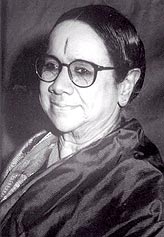
Guru Rajee Narayan was a rare combination of Bharatanatyam guru, musician, composer and choreographer, with the unique distinction of teaching not only Bharatanatyam, but also Carnatic Music, Natyasastra and Nattuvangam.